
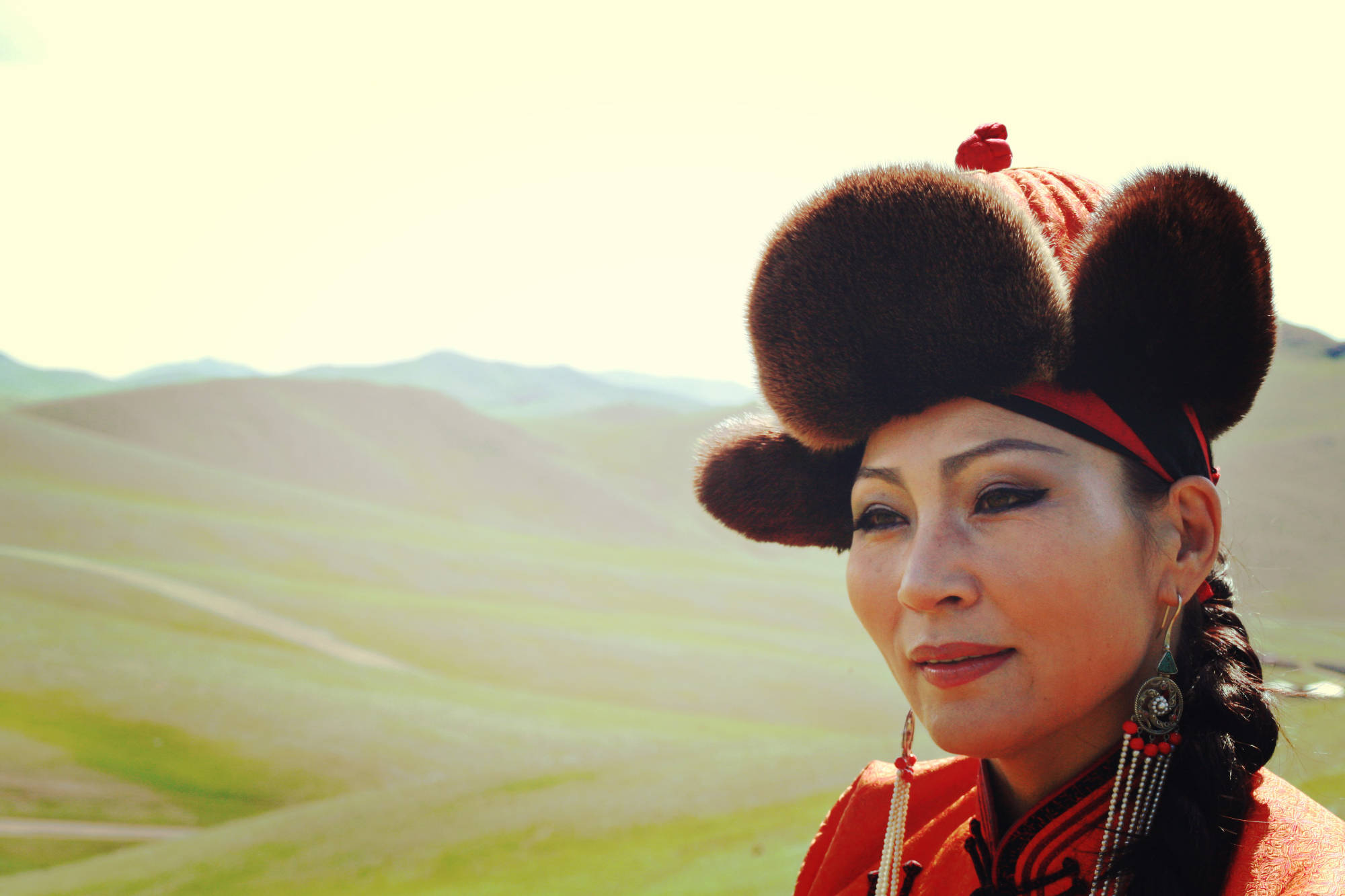
Musicians
- Erdenetsetseg Khenmedekh: urtyn duu long song, bogino duu short song
- Navaandemberel: morin khuur horse-head fiddle
- Erkhes Otgonbayar: limbe flute in circular breathing
Have you ever imagined that a melody could follow the contours of a landscape? This is what the Mongols sometimes say to explain the origin of long singing.
Unlike khöömii (throat singing), practiced by a few hundred individuals and well-known abroad, this is a vocal technique widespread throughout Mongolia and Inner Mongolia (China), shared by several ethnic groups, whose execution varies from region to region, depending on the singers and also on whether one is facing the steppe, the mountains, or the desert. This singing is called “long” because the melodies linger slowly from one syllable to the next, sometimes traversing, in the space of a breath, a variety of vocal techniques and ornaments: rapid transitions from chest voice to head voice, glissandi, laryngeal tremolos, glottal accents, powerful and then light and airy nuances, all unmeasured.
It can be a cappella or accompanied by a horse fiddle (morin khuur) or a bamboo transverse flute (limbe) played with circular breathing. The instrumentalist follows and supports the singing.
With sacred, symbolic, or philosophical themes, it is traditionally sung at wakes, weddings, and children’s first haircut ceremonies; at the Naadam festival to accompany the wrestling matches or encourage the horses and riders at the start of the race; and also at state ceremonies. In these contexts, it can be sung by a single person or by an entire assembly. Popularized during the Soviet period, its originally long performance, lasting approximately 15 to 40 minutes, has been reduced to one or two verses, ranging from three to five minutes for standard stage performances.
Despite its inscription on UNESCO’s Representative List of the Intangible Cultural Heritage of Humanity since 2008, the concept of nomadic time in the context of globalization has brought about changes: the capacity to listen to and memorize melodies has been greatly reduced, and the urtyn duu occupies less and less space in domestic ceremonies, supplanted by music reflecting our current, shorter, more rhythmic perception of time, such as pop or variety music. Needs change, traditions change, and so does the music that accompanies them.
Singers who once knew hundreds of long songs, performed in various contexts to meet community needs, are no longer commonplace. Nationwide, only about sixty are still regularly performed today, and rarely in their entirety. While Mongolians may have heard long songs, and perhaps some foreigners as well, the opportunity to hear one in its entirety is a rare and endangered occurrence.
With one of the greatest performers of this genre, this unique, all-female program will allow you to experience the beauty and richness of these steppe melismas, challenging recent performance trends and reviving the true depth of the urtyn duu art.
Erdenetsetseg Khenmedekh
A singer of traditional Mongolian long songs, of the Khalkh ethnic group.
Erdenetsetseg Khenmedekh was born in 1972 in Dundgovi Province, known as the “cradle of song.” She is a guardian of the long song tradition, particularly the Borjigon and Bayan Baraat styles.
A singer of long songs for three generations, she is dedicated to researching rare and ancient aspects of her practice in order to restore and transmit the pieces. She has been singing, studying, and teaching long songs for over 30 years and has more than 60 long songs in her repertoire.
Erdenetsetseg has worked as a soloist at the National Traditional Arts Theatre in Ulaanbaatar and the Central Khalkh Song Theatre in Mandalgovi, the capital of Dundgovi Province.
A multifaceted artist, Erdenetsetseg has successfully combined the tradition of long song with rock, jazz, and world music styles in various artistic projects, including: the pioneering rock-fusion quintet “Ajnai khuur” (1995-2014), the ethno-rock group “Altan Urag” (2002-2019), a jazz duo with pianist Chinbat Batmönkh (2014), and a hip-hop project with the Ice Top crew (2020-2025).
Erdenetsetseg published her book “From Giingoo to Long Song” in 2019. Alongside her long song practice, she also showcases traditional short song accompanied by the khuuchir fiddle and the shanz lute. A skilled seamstress, she creates her own stage costumes.
References
International tours, Bolchoï Theatre Russia, UNESCO’s headquarters, Fuji Rock Festival Japan, Plenitude World Music Festival, movie soundtracks (Khadak, Mongol, Marco Polo). « Anthology of Mongolian Khöömii » tour : Opera house of Rennes, Opera house of Lille, Musée des Confluences, Alhambra- Genevea ; Opera house of Nantes, Théâtre de la Ville of Paris… International tours: Japan, Russia, China, South Korea, Taiwan, France, Switzerland, Italia, Spain, USA…
Concert references
Théâtre de la Ville – Paris (FR), Opera House of Nantes (FR), Musée des Confluences (FR), Elbphilharmonie (DE), Les Détours de Babel Festival (FR), guest at Tengerton’s showcase official selection Babel Music XP 26…